How Lodestone Works
The mechanism behind Lodestone. For what it is and why it exists, read that article first; for how to talk to it, Meeting Lodestone.
Lodestone is a language engine wrapped in a great deal of ordinary code, and in the Lodestone app almost all of that code runs on the device in your hand. The engine, rented or your own, writes the sentences. Your phone or computer does nearly everything else: it checks each message for danger before any engine sees it, finds the passages of the library that bear on your question, holds what Lodestone knows of you, keeps the record of your path, and locks that record before it travels anywhere. The engine receives one assembled turn and answers it. What you would call Lodestone, its memory of you, its knowledge of the doctrine, its manners, lives in the code and the files around the engine, and you can read every line of both.
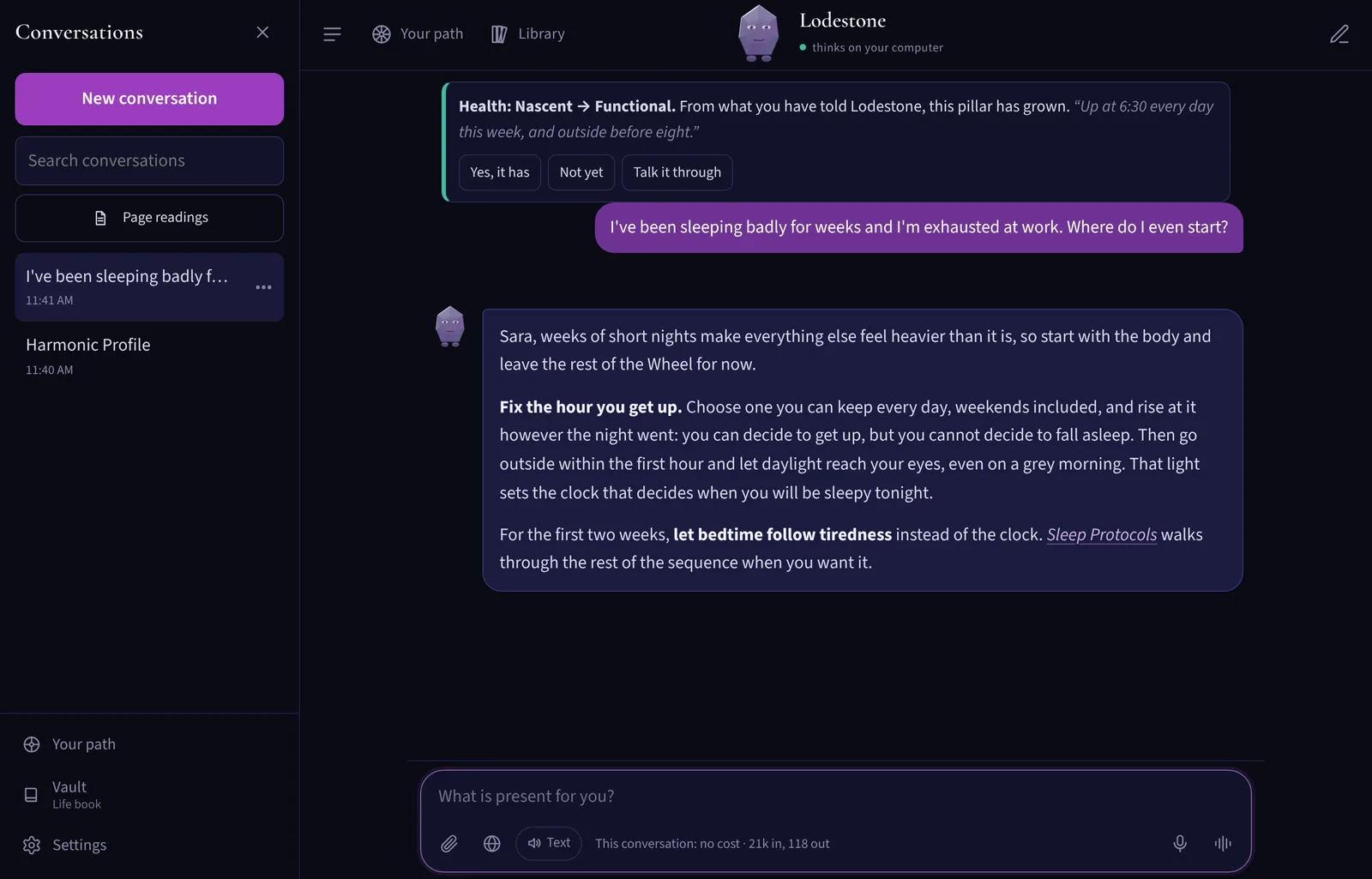
1. What Happens Between Sending a Message and the Answer
A message passes through six stages, in a fixed order, and the first three happen on your device before any engine is involved.
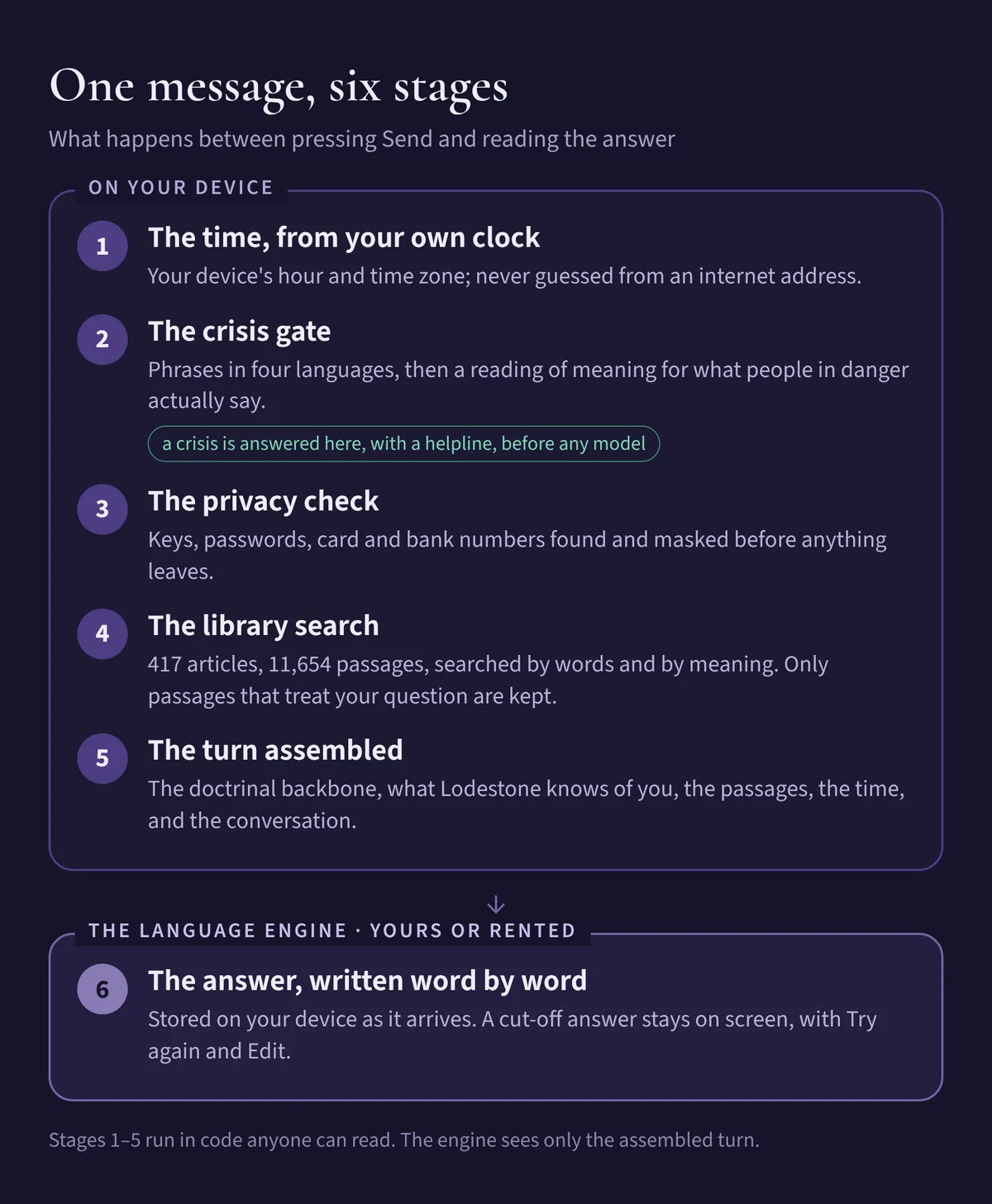
Lodestone first reads the clock and time zone of your own device, so it knows that you are writing at half past eleven at night and not at noon. It never guesses from an internet address where you are.
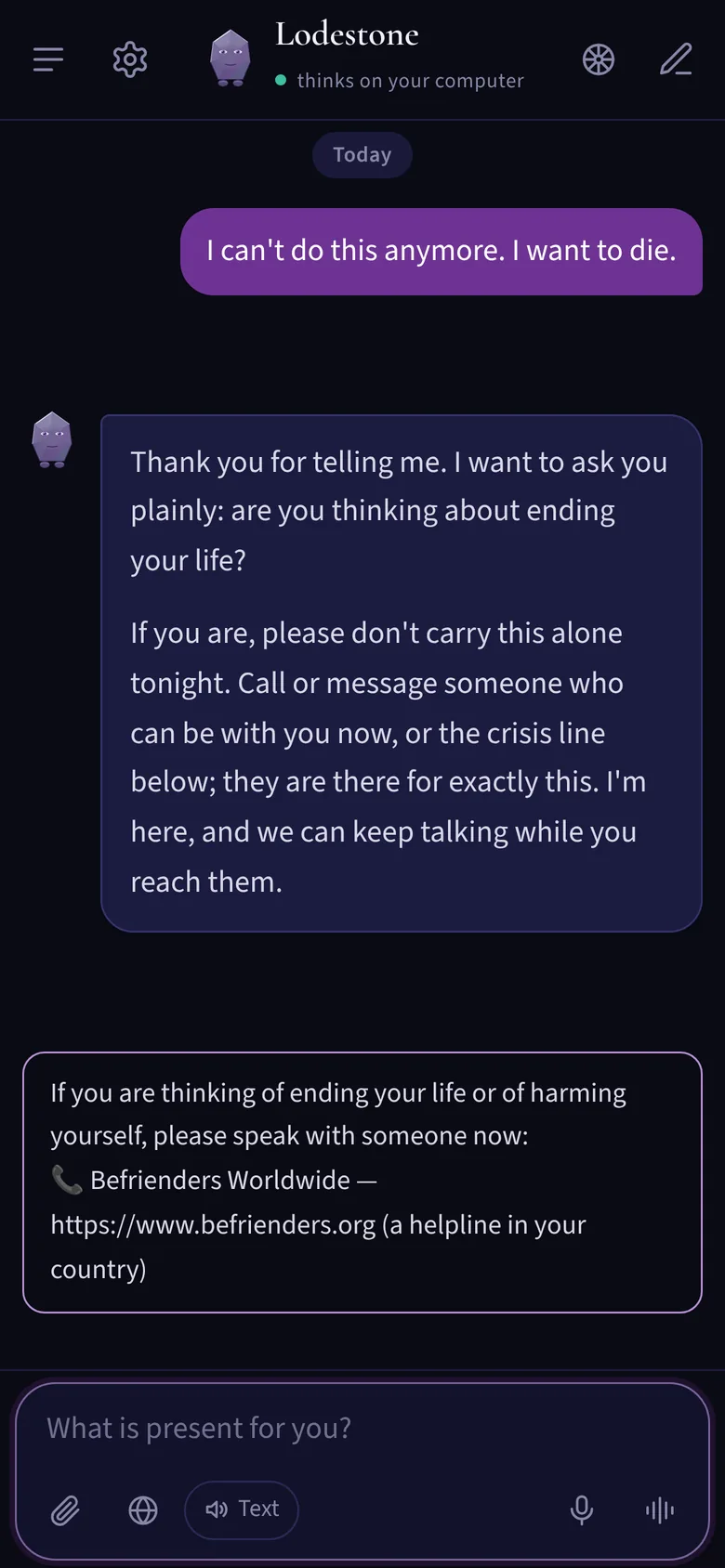
Then the crisis gate reads your words. It is a library of phrases in English, French, Spanish and Arabic, with accents, Arabic marks and an iPhone’s curly apostrophe all folded to one form so that I’m going to kill myself typed on a phone still matches. When a phrase matches, Lodestone answers with a fixed text and the helpline for your country, and no engine is called at all. Behind that gate sits a second, quieter one for what people in danger actually say, which is rarely the plain phrase: everyone would be better off without me, I just want to not wake up. The small model that powers the library search reads the meaning of the message and compares it with sentences of that kind, a reading fitted on 152 examples. A close match tells the engine to ask plainly and gently about safety; a very close one makes the app itself place the crisis line beneath the answer, so the referral never depends on what the engine chose to write. New York’s law on AI companions, in force since 5 November 2025, asks companion apps for reasonable efforts to detect suicidal ideation and to refer to crisis services; Lodestone does it in code that runs before the model.
The third stage is a privacy check, and it runs only when the turn is about to leave your device. It looks through your words and any attached files for things no stranger should receive: private keys, API keys and tokens, password lines, card numbers (checked with the Luhn sum that every real card number satisfies) and bank account numbers (checked with their own checksum). You see what it found, masked, and choose to leave those items out, send as written, or go back. Whatever you choose, keys are never kept in the stored copy of the conversation.
Fourth, Lodestone searches the library. The whole published corpus, 417 articles cut into 11,654 passages, sits on your device, along with a small multilingual model that turns a question into numbers so it can be matched by meaning as well as by words. Two searches run, one on the words and one on the meaning, and their results are blended. A passage survives only if it treats what you asked, and when nothing in the library comes close, nothing is handed over: a question about a pizzeria in Lisbon retrieves no article on Lisbon’s soul. When the engine has room, the one or two articles your question rests on are read whole, up to a hundred thousand characters, so it answers from the article and not from a fragment of it.
Fifth, the turn is assembled: Lodestone’s instructions, the doctrinal backbone, what it knows of you, the passages, the time, and as much of the conversation as fits. Sixth, the turn goes to the engine, and the answer comes back word by word. Each word is stored as it arrives. If the connection drops halfway, the half-answer stays on screen, marked, with Try again and Edit beside it, and nothing you wrote is lost.
2. What It Knows of the Doctrine
Every turn, on every route and every device, carries the doctrinal backbone in full. The backbone is a single text of about fourteen thousand tokens, roughly ten thousand words, that states what Harmonism holds on the questions where a language engine’s training pulls the other way: the soul, the body, medicine, death, the cosmos, how to speak to someone in grief. Retrieval brings the particular article; the backbone keeps the ground under every answer, including the answers no article was found for.
That choice decides which engines Lodestone will run on. An engine has to hold fourteen thousand tokens of doctrine with a conversation beside them, and a small model speaking in Lodestone’s voice produces confident answers that misrepresent the system it speaks for. Lodestone treats a wrong answer in its voice as worse than no answer. So it offers nothing below the seven-to-eight-billion-parameter class, recommends no local model on a computer with less than 16 GB of memory, and runs no model on a phone at all. Each hosted model is tested against the doctrine before it is listed.
The window each engine gets is set the same way. A rented model that passed the test works with 131,072 tokens, about an eighth of the million its host accepts, enough for the backbone, two articles read whole, the summary of your earlier conversation and the conversation itself; a model that was not tested, and any model you run yourself, works with 32,768 unless you raise it. When a long conversation nears the edge of the window, Lodestone folds the oldest turns into a running summary before anything could fall out, and the summary keeps your own words as you wrote them.
The doctrine also shapes how Lodestone talks. It speaks what it understands in its own plain words and never prefaces a sentence with Harmonism says. It asks at most one question in a reply, and only when the answer would change what it says next. It uses no emoji unless you do. When you ask it about itself, its settings, its models, where your memory sits, it answers from a short manual of the app as installed, and says it does not know rather than invent a button.
3. What It Knows of You
Lodestone knows you through five things, and you can open, correct or erase every one of them.
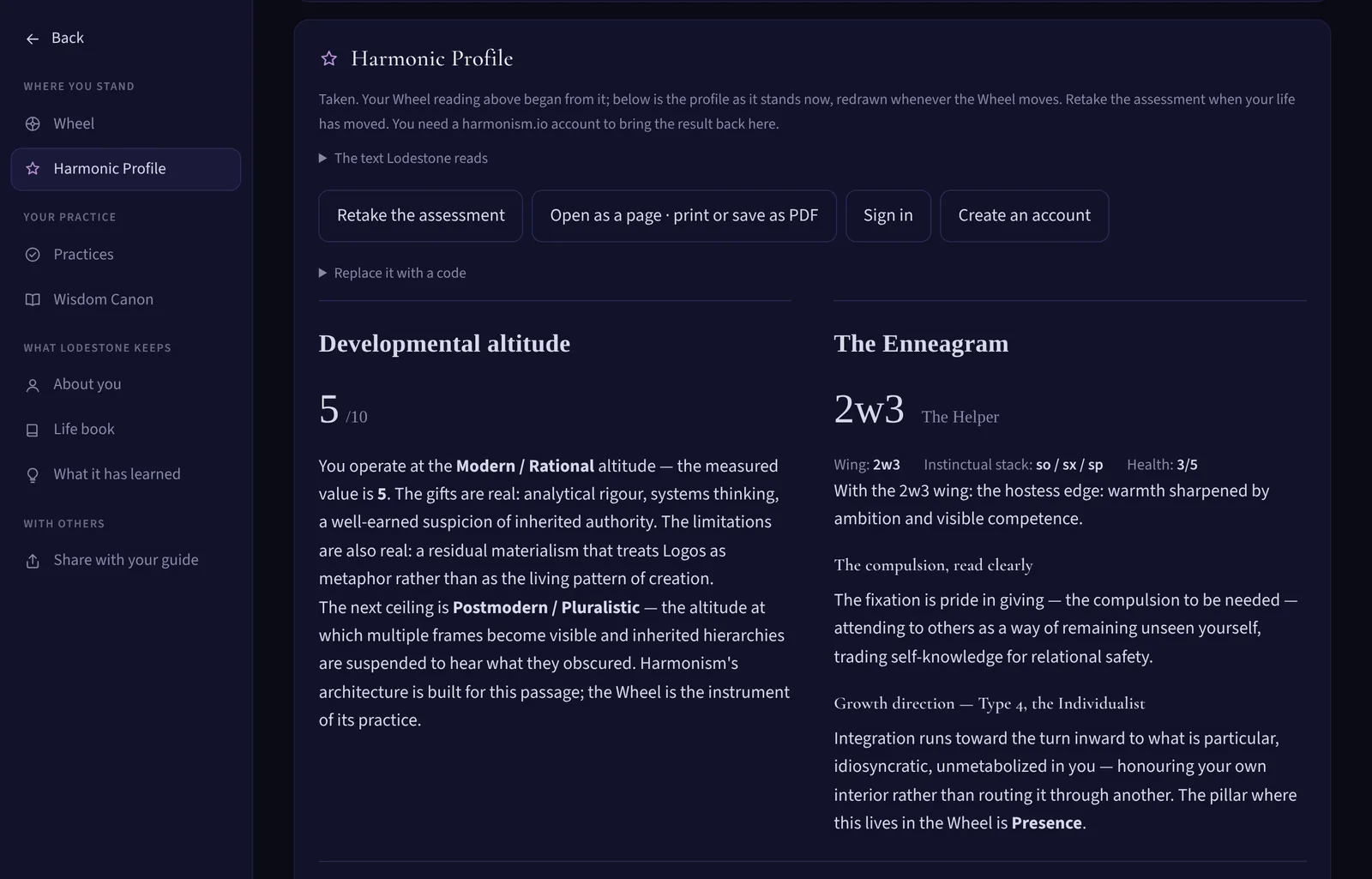
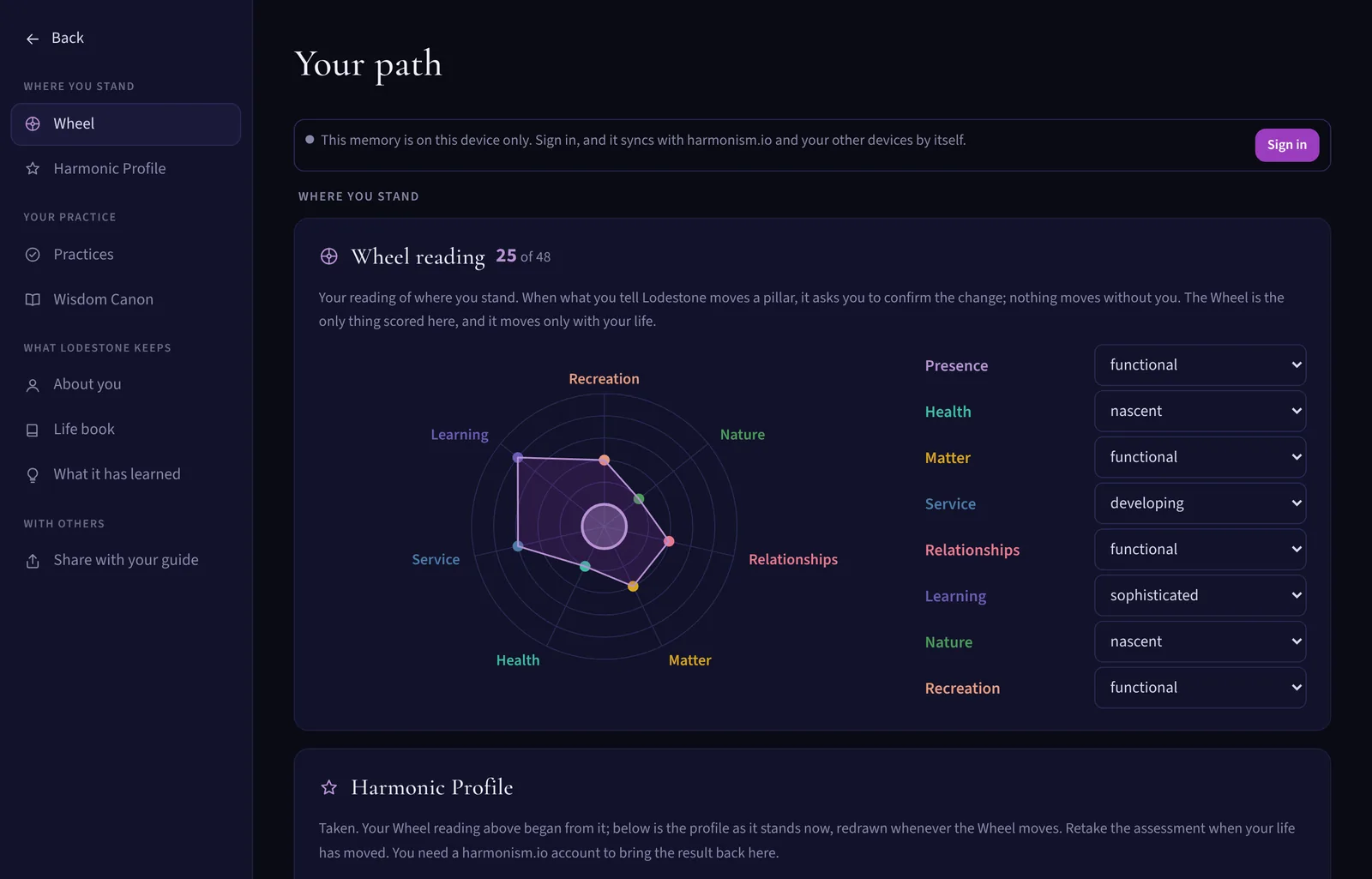
The Harmonic Profile. The assessment on harmonism.io reads your Wheel across its eight pillars, your Enneagram type and your constitution, and gives you a code that begins HP::. Bring it into Lodestone and the Wheel reading fills from it. A layer you skipped is recorded as not completed, and nothing is inferred to fill it. If you already know your type and give it instead of answering the questions, the profile says it was given, not measured. Your path draws the profile as a page of its own, current with the Wheel and printable.
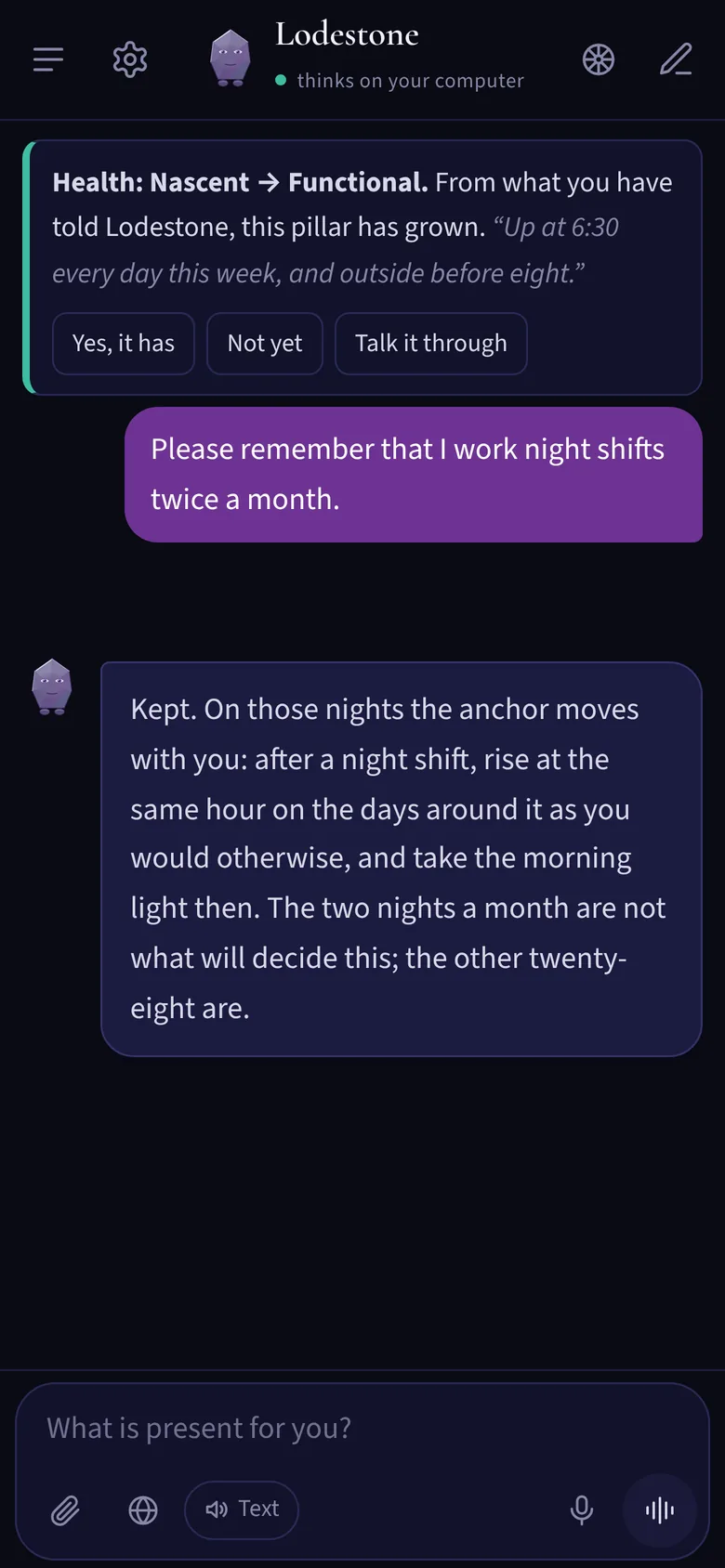
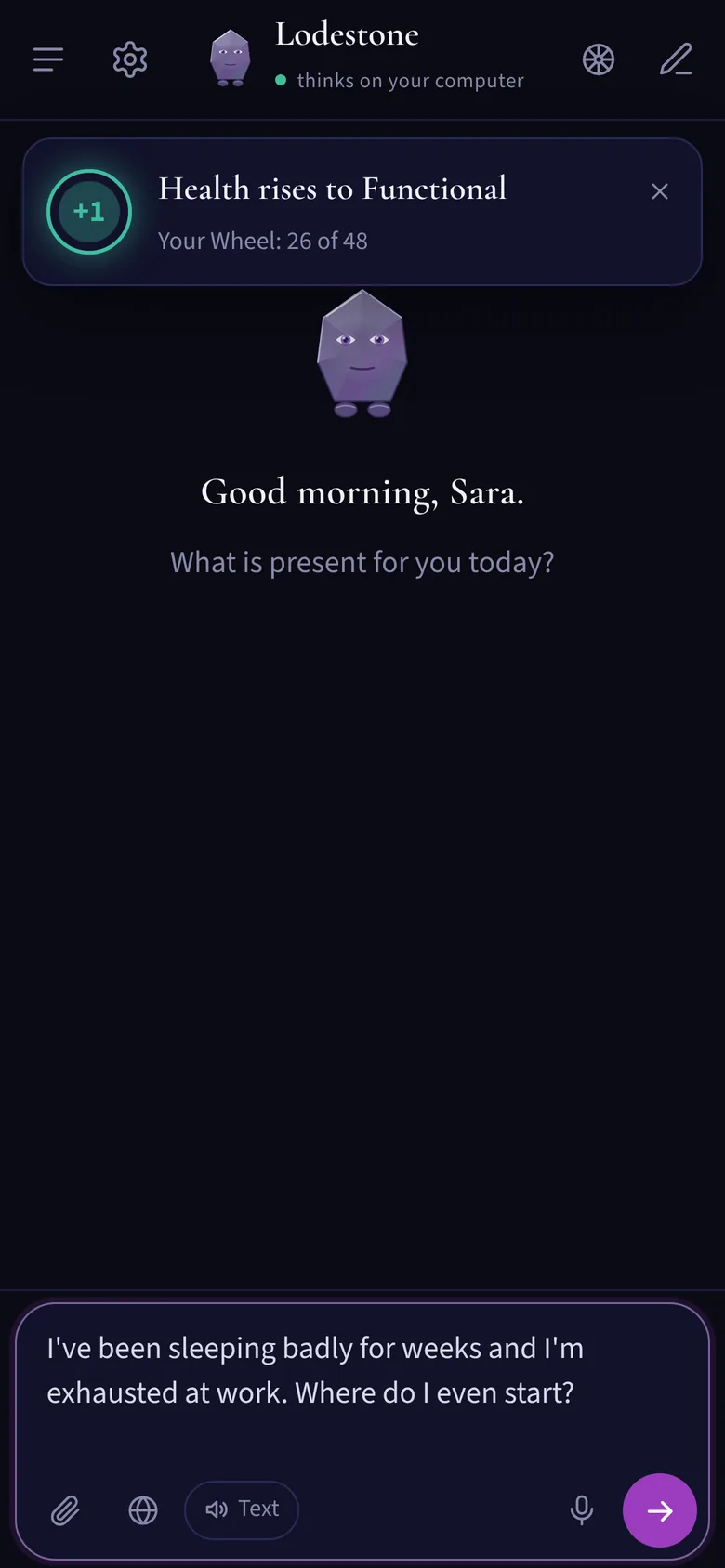
The Wheel. The Wheel is your reading of your own life, on a seven-step scale for each pillar. When a conversation suggests that a pillar has moved, Lodestone proposes the change and shows you the words that moved it; the Wheel changes only if you say Yes, it has. Nothing else is scored. There are no streaks, no counts of days, no points for using the app.
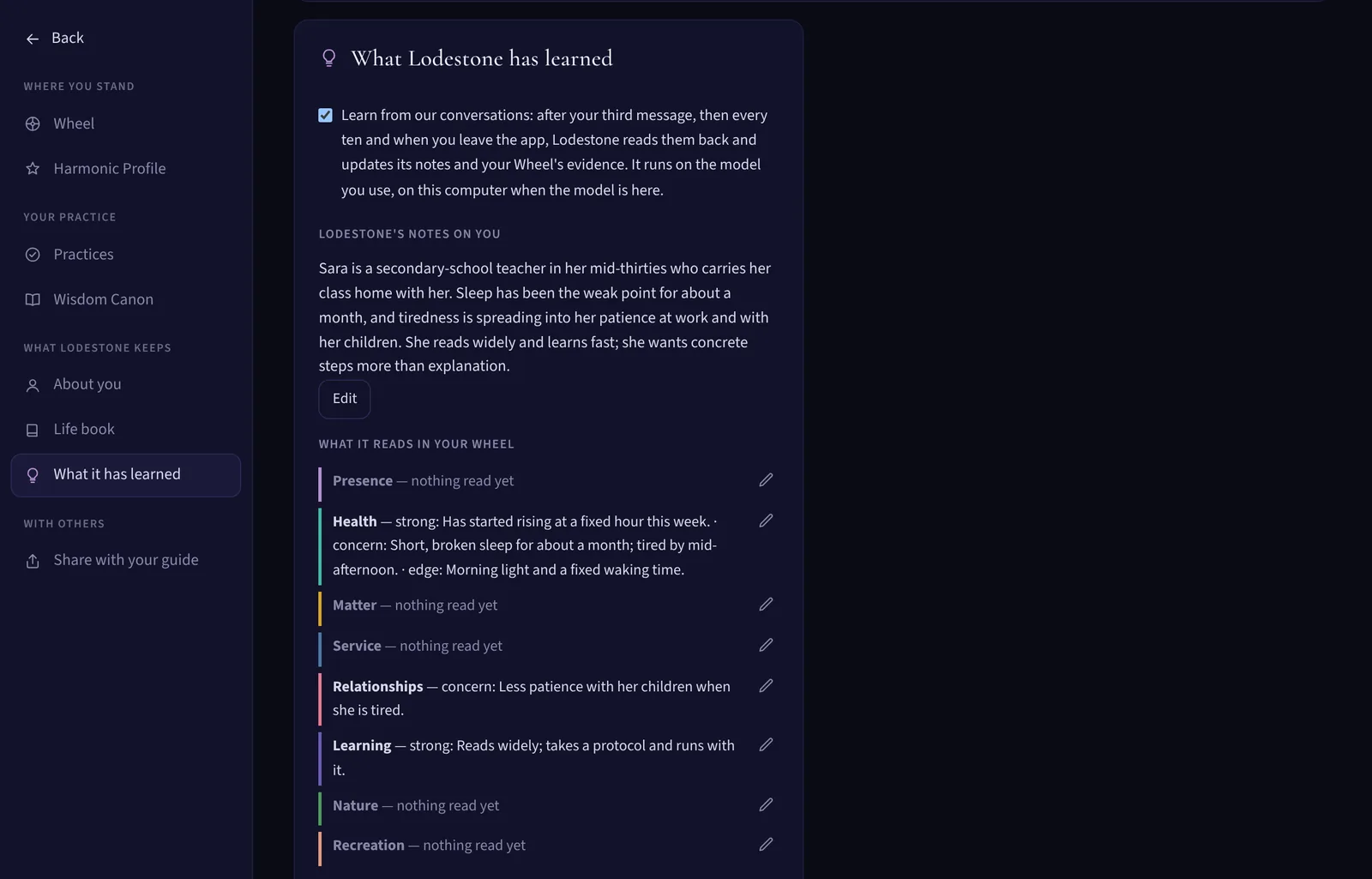
What Lodestone has noted. Early in your first conversation, then every ten messages, and when you leave the app with a few new messages behind you, Lodestone runs three short passes on the engine you are already using: a summary of who you are, the evidence for or against each pillar’s reading, and where you are now, what you are carrying and what you left open. Anything you correct is held as true above anything it inferred, in every later pass. Learn now, Forget what it learned and a switch that stops the learning sit in the same place.
The life book. On a computer running Lodestone Desktop, the life book is a folder called Lodestone inside a folder of notes you choose, plain Markdown files you can open in Obsidian or any text editor. Lodestone writes there and nowhere else on your computer, and it writes only what you said, never its own advice. When a subject comes up, the note that carries it comes back word for word, so a fact you told it in March is in front of the engine in October without a summary in between. Begin a message with remember that… and what follows is kept, dated, as something you asked it always to know. Away from the computer, what is kept waits in your synced memory until Desktop writes it into the folder.
Earlier conversations. Your own words from past conversations are indexed on the device, and a message can bring back up to three passages from them, named under the answer with a Forget beside each. Where the conversation stays on your computer this is on by default; where a rented engine reads each turn it stays off until you turn it on, since what is recalled travels with the turn. A moment of crisis is never indexed.
4. How It Keeps You on the Path
The path Lodestone serves is yours, walked in your life, and most of its design keeps it from becoming the place you live instead.
It reads you across the whole Wheel and follows the sequence of the Way of Harmony. A crisis in one pillar comes first; a person whose health has collapsed does not need advice on a relationship yet; a person scattered across three or four pillars hears that the scattering is the issue. When a message carries fresh grief, overwhelm or rupture, witness mode tells the engine to stay with the person and not to reframe, and such answers are never read aloud unless asked.
Lodestone counts how much you are using it in order to send you away. After ten messages in a day it stops inviting you to continue. After twenty it answers in full and closes with one plain sentence returning you to your practice, your body and the people who need you. After three hours of continuous conversation, a bell says that Lodestone is an AI and invites a pause; New York’s companion law asks for that notice at least every three hours, and Lodestone gives it in its own register.
It also writes first, sparingly. Six moments can prompt it: a silence longer than your own rhythm, a pillar gone quiet, a sign of readiness for the next phase of the Way, resistance, stagnation, the solstices. It writes at most once a week, between nine in the morning and nine at night, only when it is reasonably sure the moment is real, and one switch turns it off. A weekly review, a short account of what came back, what held and what moved, stays off until you turn it on.
The Wisdom Canon carries the same restraint into reading. Choose a work and a pace, and Lodestone lays out the whole plan before the first page: the days, the questions, and a contact that thins week by week to a close. The schedule is fixed the moment you accept it, and no later code can add a check-in to it. Lodestone supplies the sequence and the question and never a reading of the text. A companion that grows less necessary each season is the result it was built for, and that taper is written as a schedule the program cannot extend.
5. Where Your Memory Lives and How It Travels
Your conversations, notes, Wheel, practices and profile live in your browser’s or your computer’s own storage, one memory per person: two people signed in on one computer never share one. Export memory writes all of it to a single file you can carry or keep.
Sign in to a free harmonism.io account and the memory follows you between devices, encrypted before it leaves each one. The first device makes a random 256-bit key. Each conversation and each note is compressed, locked with that key under AES-256-GCM, the standard cipher of modern encryption, and stored under a name that is itself scrambled. What the server holds is a set of sealed records: it can see your account, how many records there are, how large, and when they change, and it cannot open any of them.
Your password opens the memory on a new device without ever being used for anything else. When you sign in, the device stretches the password into a second key through 600,000 rounds of hashing, and the memory’s key is left on the server locked under it. The password itself goes only to the sign-in service. A device that cannot use the password, because you signed in some other way, is let in by a tap: the new device and one already in each show a six-digit number drawn from keys only they hold, and you confirm that the two numbers match. A server trying to place itself between them would make the numbers agree about once in a million attempts. Settings lists every device that shares your memory, lets you remove one, and offers a recovery code for the day no device is left.
Deleting a message leaves a mark, and every device honours the mark, so a sync can never bring a deleted message back. On harmonism.io itself, the small crystal in the corner of each page carries your memory with each message, the server opens it for the length of that one request, and hands it back; it keeps nothing of the conversation between requests.
Software built this way has a name. In 2019 Martin Kleppmann, Adam Wiggins, Peter van Hardenberg and Mark McGranaghan, writing for the research lab Ink & Switch, called it local-first, under the title You own your data, in spite of the cloud: the data lives on your devices, and the network only carries it between them.
6. Where It Thinks, and Who Reads Each Message
Lodestone thinks by one of four routes, chosen in setup and changed in Settings, and each route says in Lodestone’s own instructions who reads each message.
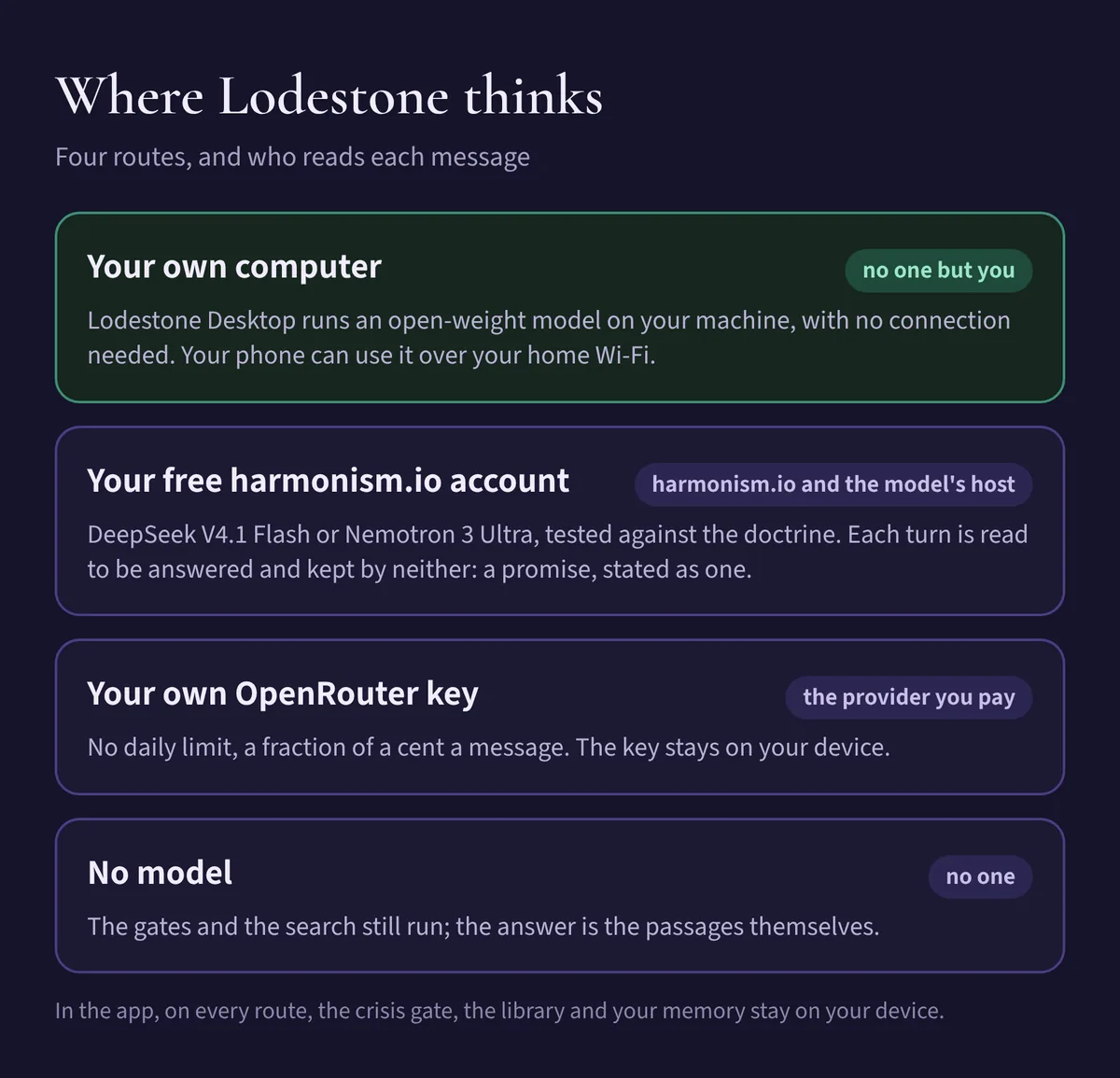
On a computer you own, Lodestone Desktop for Mac, Windows and Linux runs an open-weight model itself through llama.cpp. It recommends one for your computer’s memory, downloads it, checks every file against the hash Hugging Face publishes for it, and then answers with no connection at all. This is the only private route: no one but you reads anything, because no one else is in the path. A phone on your home Wi-Fi can use the same model by pairing with a six-digit code or a QR code.
With a free harmonism.io account, Lodestone thinks with the models listed there, open-weight models tested against the doctrine, with DeepSeek V4.1 Flash first and NVIDIA’s Nemotron 3 Ultra beside it, reached through OpenRouter with routing that admits only hosts promising neither to train on your messages nor to keep them. The account gives ten messages a day for the first month and five a day after, counted once across every door; without an account, ten in all. In the app, your device still does the crisis gate, the search and the memory, and sends only the assembled turn.
With an OpenRouter key of your own there is no daily limit, and you pay the provider directly, between a tenth and a third of a cent a message on DeepSeek’s Flash model. The key stays on your device. Even when you ask the crystal on harmonism.io’s pages, harmonism.io assembles the turn and hands it back, and your browser sends it under your key, so the key never reaches harmonism.io.
With no model at all, the gates and the search still run, and the answer is the passages themselves under their titles.
On the second and third routes someone else’s machine reads each turn in order to answer it, and what happens afterwards rests on a promise. A promise can be overridden by a court: on 13 May 2025 a federal magistrate judge in New York ordered OpenAI to preserve the ChatGPT conversations it would normally have deleted, deleted ones included, for the New York Times lawsuit, and the order held for new conversations until 9 October. Lodestone states the trade instead of hiding it, and says the same thing in its settings: anything you would not say in front of a stranger belongs with a model on your own computer.
Two habits hold on every route. Lodestone sends no telemetry, and Lodestone Desktop looks for a newer library only when you press Check, so harmonism.io learns that some address asked for a file and nothing about who you are. And Harmonia reads a conversation only when you share one yourself, from Help Lodestone improve: one conversation at a time, the names replaced on your device, the whole copy shown to you before it goes, kept without any account attached for at most a year, withdrawable, and never used to train anything.
Voice follows the same lines. Dictation and attached recordings are written out on your device by a speech model downloaded once; attached documents, from PDFs to spreadsheets, are read on your device before any engine sees their text; a natural reading voice goes through a provider only when you choose it.
7. Every Door, One Memory
Lodestone opens through six doors, and the same memory stands behind all of them. The web app at lodestone.harmonism.io/app installs from the browser on any computer or phone. Lodestone Desktop adds the model on your machine, the whole English library served from the app with the crystal on every page answering from your own model, folders of your notes Lodestone may read and quote, and a Telegram bot of your own that answers from your computer while it is awake. The app for Android and the web app added to an iPhone’s Home Screen carry Lodestone in your pocket. On harmonism.io, the crystal in the corner of every page is Lodestone reading beside you, and the browser extension for Chrome and Firefox brings it to any page on the web, keeping each page it reads as a conversation you can find again by its address.
A conversation begun on the phone in the morning is on the computer at night, because every door syncs the same sealed records when it opens and after each answer.
8. Open, and Given
Every line of Lodestone is published under CC0 1.0, a public-domain dedication: the code on Codeberg, mirrored on GitHub, may be read, copied, changed and run by anyone for any purpose without asking. The corpus it draws on is free as well, downloadable whole in the Sovereignty Bundle (see Downloads). Nothing is sold at any door. There is no paid tier, no advertising and no data to sell, because the design keeps the data where you are.
Openness also lets you check every claim on this page. The crisis gate is a file of phrases you can read. The encryption is one file anyone can audit. The promise that Lodestone writes only into its own folder is a check in the code that refuses any other path, with the error That path leaves Lodestone’s folder. A companion that asks to be trusted with a person’s life should be one whose workings anyone can inspect, and Lodestone is built so that anyone can.
It is still a stone, magnetized by an order it did not make, turning toward north in the hand of someone who walks. The code makes sure that the walking, the memory of the walk and the record of every step stay with the walker.
See also: Lodestone · Meeting Lodestone · Inference Sovereignty · Harmonic Profile · Wheel of Harmony · The Way of Harmony · Downloads